For curious kids, summer programs aren’t just fun—they’re formative. When designed intentionally, summer camps promote lifelong skills, including independence, confidence and creative problem-solving.
In our modern world, these skills are more valuable than ever. With fewer in-person opportunities to connect and AI built into nearly everything, navigating today’s landscape can be challenging for anyone. Summer camps give kids daily opportunities to practice social-emotional learning (SEL) and develop critical thinking skills.
Naturally, these skills can help young minds excel in college and the workforce. But, more importantly, independence and confidence are essential to living. Kids who learn social-emotional skills early are more likely to enjoy a healthy mind and stronger relationships throughout life.
At Camp Galileo, a big part of our mission has always been to foster these necessary skills. By combining fun with meaningful opportunities to learn and grow, we inspire kids to become innovative thinkers, doers and dreamers.
Over the years, countless studies have shown that summer camps play a pivotal role in childhood development. This guide explores those findings, shining light on the many benefits of summer camp programs for your child.
Inside the Research: The Value of Summer Camp
For decades, childhood development researchers—and parents, for that matter—have studied the psychological benefits of summer camp, recognizing its lasting impact on children’s confidence, independence, and emotional well-being.
Between 2001 and 2004, the American Camp Association (ACA) analyzed 5000+ campers across 80 summer camps. Their 2005 study found that kids who attended camp displayed significant growth in hard and soft skills like:
- Independence
- Self-esteem
- Decision-making
- Building friendships
More recent studies have discovered similar results. Over the years, researchers have found that youth summer camps lead to:
- Improved confidence – One study of a four-week program found that kids felt a stronger sense of self-esteem afterward. Another one-week program left campers with an improved ability to advocate for themselves. In other words, camp provides kids with a stronger sense of self, even after the program ends.
- Increased self-determination – A 2024 publication also found that participants in a two-week program showed more assertiveness and emotional self-control. These campers were able to better manage their thoughts and feelings independently from outside influence.
- Stronger methodical skills – Many camps—especially those that emphasize learning—allow kids to practice math, reading comprehension and other technical skills that help with solving problems. Plus, studies show that the interpersonal skills that assist with group problem-solving, such as collaboration and empathy, also develop at camp.
These independent studies match the anecdotal experiences of Camp Galileo campers. In just one week, many attendees report more confidence or better memory retention. As one parent said in 2024:
“My kids always love it and come home thinking more independently and deeply than before.”
Testimonials like these from campers and parents—as well as the latest research from childhood development experts—have shaped and validated Camp Galileo’s intentional curriculum. The Galileo Innovation Approach (GIA) instills kids with the knowledge they need to think outside the box, and a mindset that empowers them to put their new skills to the test—all with having fun as a core philosophy.
Building Confidence Through Exploration and Safe Risk-Taking
For kids, confidence means many things. It’s the ability to trust themselves, to try new things and to approach challenges fearlessly and bounce back from failure.
Summer camp is full of brand new experiences and obstacles, making it the perfect place for kids to discover—or build—their confidence.
Plus, summer programs offer a uniquely safe space for kids. Away from any typical expectations, kids are free to break out of their comfort zones. They’re free to make mistakes, tackle obstacles and experiment with unlikely approaches, all without any judgment. There are no grades to achieve and no relatives to impress with perfection. Instead, there are just endless low-stakes opportunities to take safe risks.
Opportunities for Personal Growth
Many classic summer camp activities gently nudge kids beyond their comfort zones and toward personal growth. These moments include:
- Performances – Whether it’s showing off a model rocket or reciting a self-written monologue, presenting to peers is a typical part of the summer camp experience. These opportunities give campers a low-pressure chance to try public speaking.
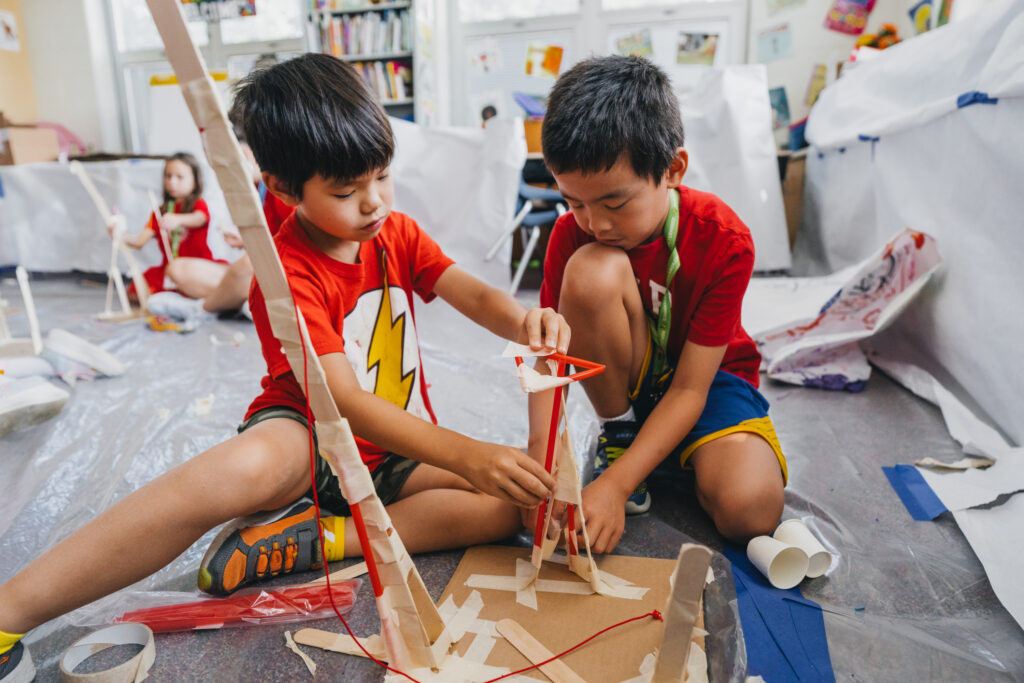
- Team efforts – Small group projects are also common at summer programs, particularly at STEAM-focused camps like Camp Galileo. Kids work together to solve problems and complete activities. Not only does teamwork encourage kids to develop a healthy respect for differences of opinion and preference, but it also helps them find their unique voice and point of view in group activities.
- New experiences – At most summer camps, kids will encounter games, challenges or situations they have no prior experience with. When faced with these never-before-seen scenarios, kids may feel a sense of fear or hesitation. But with support from counselors and fellow campers, kids soon realize they can do anything they set their mind to, even if they’ve never done it before. These moments can help inspire future confidence.
- Trying and failing – With so many novel experiences, failure is only natural. But failing, then working to recognize the cause for failure and address it, is an essential part of childhood development. Rather than protecting kids from failure, camp gives them a safe space to try new things and the encouragement to get back up when they fall.
All of these experiences help kids become braver, more self-aware and, above all, more confident.
Creating Confidence-Building Moments
While many confidence-inspiring moments happen naturally in a summer camp environment, counselors and program directors can take steps to further foster a child’s self-esteem. At Camp Galileo, we intentionally create confidence-boosting experiences for campers by prioritizing:
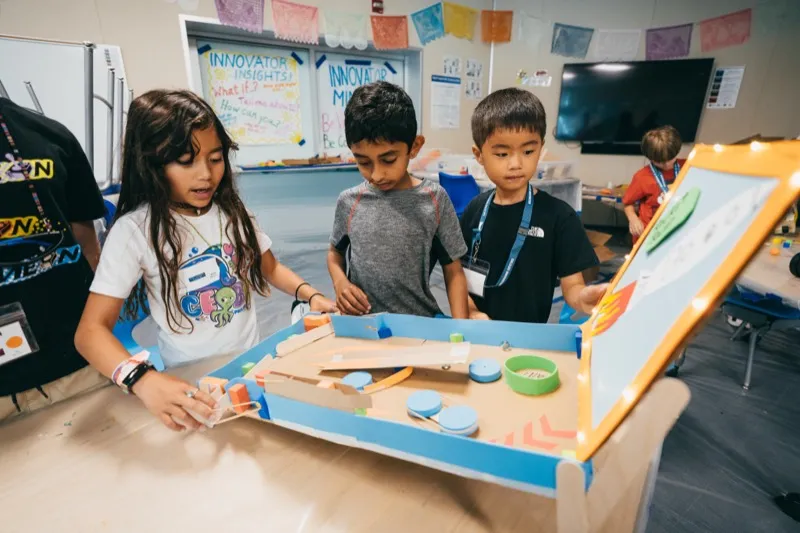
- Open-ended projects – In our Innovator’s Studio and Idea Lab, kids have the freedom to tackle design challenges however they choose. Some projects may have a goal, but more importance is placed on creativity than perfection. This encourages kids to confidently experiment, make mistakes, build resilience and take risks.
- Team-based activities – Along with solo projects, campers also engage in activities with their peers. These group opportunities normalize sharing, feedback and iteration—all skills that nurture self-confidence.
- Counselor support – At all times, campers can turn to their mentors and role models for guidance and strength. Our counselors celebrate each child’s courage and effort, helping campers feel more comfortable in their own skin.
Growing Independence in a Structured, Supportive Environment
As campers develop confidence in who they are without the input of others, they gain a sense of independence. In fact, these qualities grow hand-in-hand: kids who demonstrate independence exhibit more confidence, motivation and self-esteem.
Like confidence, independence is a critical developmental milestone. From a young age, kids are dependent on those around them—because they have to be. But as kids reach early and middle childhood, they spend more and more time away from their families (at school, daycare or sports) and must learn to think for themselves.
So, in a sense, an independent child is a sign of a job well done. If the goal of parenting is to prepare kids for “the real world,” independence is the ultimate outcome.
Summer camps have the same goal. Bonding and relationship-building are part of the package, but all of that must happen independently, away from relatives and familiar faces.
Camps also have the advantage of being an unfamiliar place—a place where independence is not just encouraged, but necessary. For this reason, kids often rate camp as the best setting for practicing independence, ranking it much higher than school or home.
Being away from home—even for a day—lets kids practice autonomy, self-accountability and decision-making in a safe, supervised environment.
Camp: Where Kids Make the Choices
Of course, summer camps are structured programs with schedules and activities. But even within those schedules are thousands of moments where kids must think and act independently.
Many developmental moments at camp call for independence, including:
- Managing daily routines – Every day, kids at camp must keep track of their belongings, prepare materials for projects, choose where to eat and much more. Each of these actions might seem small, but when looked at together, they paint a picture of an independent person.
- Making decisions in group settings – Kids must also make decisions as a team—independently from adults. For instance, during group activities, kids work together to figure out how to approach a task and who should take on which role.
- Navigating conflicts – In any group situation, there’s a chance that conflict might arise, and summer camp is no different. Occasionally, kids will disagree or come across challenging situations. Working through these scenarios without intervention happens all the time, though counselors are always available to help settle arguments and support campers when necessary.
The Importance of Structure at Camp
While kids at camp will make plenty of solo discoveries, childhood independence doesn’t mean total non-involvement from adults. Structure is a fundamental part of summer camp—kids aren’t simply left to figure everything out alone.
The trick is to create an environment that promotes autonomy even within this structured environment. For instance, rather than micromanaging every moment, staff at Camp Galileo give kids the freedom to learn and grow within a thoughtful framework of support.
In childhood development, this concept is known as “scaffolding.” Scaffolding provides kids with the temporary support they need to try something new without fear. As campers progress, counselors can remove these supports. They understand when to step in and when to stand back and observe.
Think of scaffolding like training wheels: At first, kids can’t imagine biking without them. Then, before they know it, they’re riding independently on two wheels.
Overall, when campers are encouraged to explore, lead and self-direct in a safe environment, they gain the courage they need to be more self-sufficient.
Strengthening Problem-Solving Skills Through Hands-On Learning
Summer camps help kids develop social-emotional skills like self-assuredness and autonomy. But many camps—particularly hands-on, STEAM-oriented options like Camp Galileo—also nurture more methodical skills, like critical thinking and troubleshooting.
That’s because young minds learn best when they’re actively doing—not just listening or memorizing. STEAM-oriented programs prioritize active learning through science experiments, technology and engineering tasks, art projects and math activities.
By combining these hands-on experiences with play, kids learn to think critically, take risks, collaborate, problem-solve and flex their creative muscles, too.
A Typical Camp Challenge
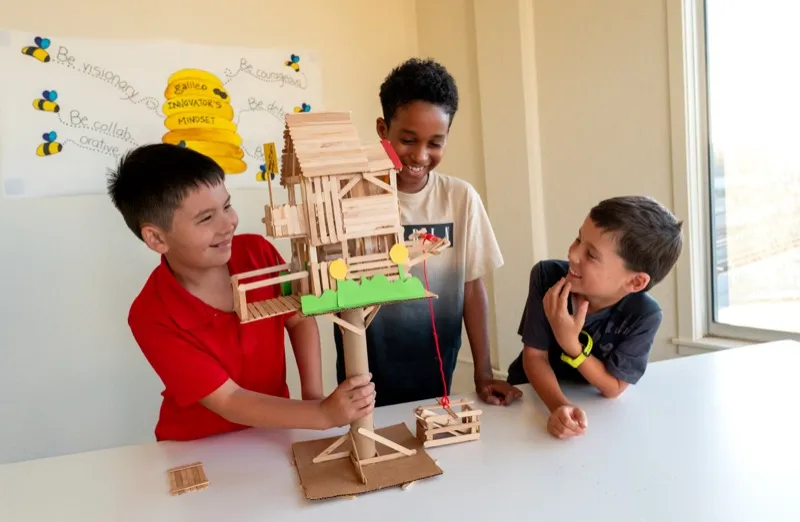
Because hands-on creativity has been shown to improve problem-solving skills, Camp Galileo purposefully designs challenges for campers to overcome. Almost any activity can be turned into an exercise in critical thinking, but no matter the project, the framework is more or less the same.
Here’s a breakdown of that framework using a building challenge as an example:
- Start with an open-ended idea – First, kids are presented with a question like, “How tall could you build a tower out of everyday materials?” With few limitations and no definition of success, challenges like these let campers dream big and attempt outside-the-box strategies.
- Brainstorm and iterate – Once an idea takes shape, kids can prototype, test and revise their designs. Along the way, they collaborate with peers and counselors, working to solve problems as they arise.
- Present the project – At the end of the activity, campers are encouraged to share their progress. Through presentations, the kids see how other minds tackled the same challenge. By exploring all the different ways to solve a problem, kids broaden their horizons and learn new skills for future projects.
The beauty of these creative challenges is that there’s no single “right” answer. Each kid’s curiosity will guide them to their right answer. And as kids experiment, they make new discoveries and mistakes. These built-in learning opportunities aren’t just expected, but encouraged. After all, every “mistake” is another opportunity to solve a problem.
Active Learning: The Preferred Approach
At summer camps with a STEAM-based curriculum, like Camp Galileo, hands-on learning is the primary focus. That’s because active learning engages kids better than passive instruction.
But more than that, it’s a better representation of real-world learning. Whether it’s an after-school robotics program or a college programming course, active instruction is the norm in science, technology, engineering, arts and mathematics.
By introducing kids to hands-on experiences at a young age, summer camps prepare them for the problems they’ll have to solve in the future.
Beyond Camp: How These Skills Carry Over Into Daily Life
Ultimately, summer camp is about the present and the future. From a short-term perspective, camp is just a moment—a snapshot of a summer filled with fun and sun.
But camp is more than a moment—it’s also a mindset. Summer camp experiences stick with kids long after summer ends.
The confidence, independence and problem-solving skills that kids practice at camp carry over into their everyday lives and serve as some of the most meaningful benefits of summer camp for children. Learnings from camp can motivate positive behavioral changes at home or school. In fact, Camp Galileo parents have reported all kinds of developments, including:
- Hesitant students raising their hands more confidently in class
- Kids handling sibling disagreements with more patience
- Shy kids initiating friendships with more ease
- Kids taking ownership of homework or chores without prompting
Summer camps give kids the consistency, support and space to practice these emotional and social skills. Even after just a week, countless camp moments can create lasting “muscle memory,” and self-confidence becomes second nature.
Of course, not every camp will have the same impact. All summer camps encourage social-emotional learning, but experiences like Camp Galileo are intentionally designed for even greater personal growth and fulfillment.
When approached the right way, camp doesn’t just leave a temporary mark—it becomes part of who each kid is becoming.
Choosing the Right Camp for Long-Term Growth
With all of the above in mind, parents and guardians should take extra care when choosing a summer camp for their kids.
Fun and structure are obvious features to look for. But nearly all summer camps offer schedules and playtime. Parents who want to find truly enriching and purposeful summertime opportunities for their kids should seek out camps designed with long-term developmental outcomes in mind. That way, camp can be a fun experience and an opportunity for growth.
The best camps combine exciting activities with:
- Programming that’s intentional and child-centered, not just activity-packed
- Opportunities for kids to make choices and lead projects
- A supportive environment where failure is reframed as learning
- Counselors trained to foster social-emotional growth, not just manage behavior
Finally, programs should interest the most important person involved: your child. A summer camp will only leave a lasting impression if your kid wants to go.
Camp Galileo was built to appeal to kids and parents alike. With an equal emphasis on learning and fun, Galileo takes a unique approach to the traditional summer camp experience. Our week-long programs combine creativity and collaboration with a purpose-driven learning philosophy. We’ve developed a STEAM-focused curriculum for kids that leans on the latest research in childhood development, and we’re always updating our camps to make sure kids get the most out of their experience. That’s why families come back year after year: Because it’s not just about fun—it’s about having fun while improving confidence, independence, problem-solving skills and more.
If that’s the kind of camp you want your kid to enjoy, take a closer look at our summer programming. And if you have any questions, don’t hesitate to reach out—we’re always happy to help new families find their right fit.
Sources:
Collaborative for Academic, Social, and Emotional Learning (CASEL). Fundamentals of SEL. https://casel.org/fundamentals-of-sel/
American Camp Association. Directions: Youth Development Outcomes of the Camp Experience. https://www.acacamps.org/resources/directions-youth-development-outcomes-camp-experience
National Institutes of Health. How Do Summer Programs Influence Outcomes for Children and Youth? https://www.ncbi.nlm.nih.gov/books/NBK552656/
Frontiers in Psychology. Empowering young people—the impact of camp experiences on personal resources, well-being, and community building. https://www.frontiersin.org/journals/psychology/articles/10.3389/fpsyg.2024.1348050/full
National Institutes of Health. The Effects of Summertime Experiences on Children’s Development. https://www.ncbi.nlm.nih.gov/books/NBK552668/
U.S. Department of Labor. Teamwork. https://www.dol.gov/sites/dolgov/files/odep/topics/youth/softskills/teamwork.pdf
Psychology Today. The Importance of Failure for Kids. https://www.psychologytoday.com/ca/blog/parenting-matters/202409/the-importance-of-failure-for-kids
International Journal of Primary, Elementary and Early Years Education. The importance of recognising and promoting independence in young children: the role of the environment and the Danish forest school approach. https://www.tandfonline.com/doi/full/10.1080/03004279.2021.2000468
Journal of Youth Development. Understanding the Role of Summer Camps in the Learning Landscape: An Exploratory Sequential Study. https://jyd.pitt.edu/ojs/jyd/article/view/19-14-03-FA-01
U.S. Department of Health & Human Services. Scaffolding Children’s Learning. https://headstart.gov/video/scaffolding-childrens-learning
The Harvard Gazette. Study shows students in ‘active learning’ classrooms learn more than they think. https://news.harvard.edu/gazette/story/2019/09/study-shows-that-students-learn-more-when-taking-part-in-classrooms-that-employ-active-learning-strategies/